Results

You describe symptoms that could be helped by a more detailed cognitive assessment.

This is because you describe symptoms that affect your everyday life.

What we recommend as the next step

• A better understanding of what your symptoms may be caused by through a cognitive assessment with our licensed healthcare professionals.

Please note! These test results are an estimate based on several factors derived from your answers. A more in-depth analysis requires further investigation.


Read more about how we work
Get a cognitive assessment in just 14 days, with 91% sensitivity
You will receive a professional evaluation and risk assessment based on 32 parameters—from the comfort of your own home.
Get the help you need
This is included in the assessment
Assessment by physicians who work with cognitive disorders and issues on a daily basis
Sweden's first validated digital tests to determine whether your problems may be related to dementia
Differs from traditional tests – you can't get them all right. We can therefore assess individuals regardless of their functional level.
Blood tests for further risk assessment if necessary
Get the help you needContact me


Please note! These test results are an estimate based on several factors derived from your answers. A more in-depth analysis requires further investigation.

Cognitive assessment

We can help you with a cognitive assessment if you are experiencing problems and want to understand what might be causing them.

The assessments are done fully digitally with the help of our dementia nurses and doctors, and are carried out as follows:
  1. An introductory video call with a dementia nurse to understand what problems you are experiencing and why you are coming to us.
  2. You will be asked to complete cognitive tests and answer questions about yourself from home at your convenience. If you wish, you can also choose to include family members in this part of the assessment. They will be asked questions about you and your symptoms.
  3. A video medical call with a doctor who will take you through your results, what they mean and recommended next steps. After the assessment, you will have access to your results.
Cost of cognitive assessment:
Introductory interview:
450kr
Medical consultation + recommendation:
450kr
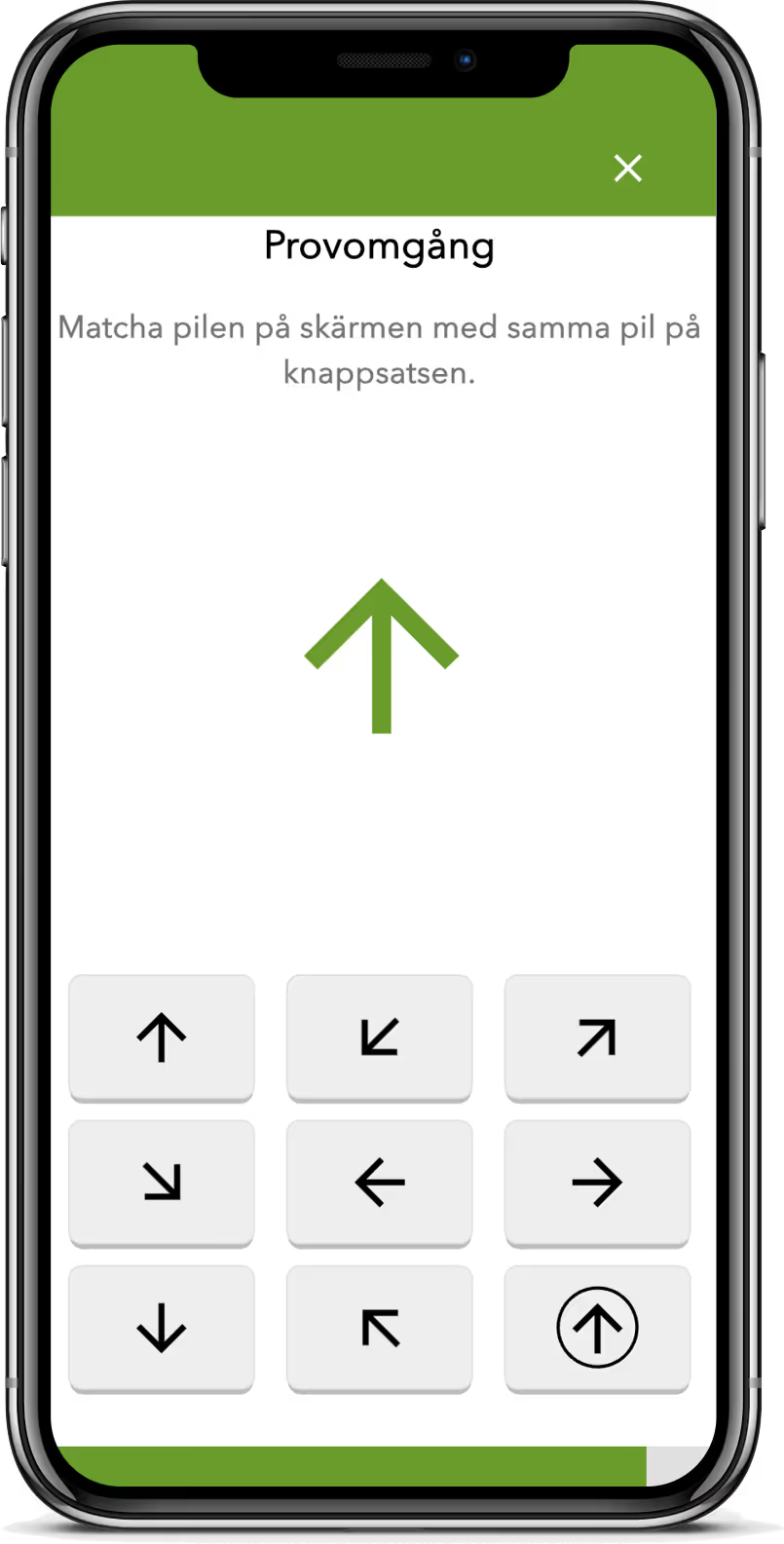
example of app test
Book an appointment for cognitive assessment

How we help your brain

Pannlobes / frontal lobes

brain virus

Function

The frontal lobe is one of the most complex areas of the brain. It sits at the front of the brain, behind the forehead, and acts as a 'boss office' for many of our most advanced and human functions.

It controls planning, decision-making, impulse control, our conscious movements and our working memory, among other things.

Example: The frontal lobe helps you to create a plan, follow it, and adjust it if necessary.
problem

The problem

  1. Difficult to solve problems
  2. Lack of impulse control
  3. Lack of judgment
  4. Impairment ability to concentrate
Solutions

Solutions

  • Train executive functions. Playing strategy games where you have to plan, prioritize and break down tasks into subtasks is also very good training.
  • Improve impulse control and emotion regulation. Practicing mindfulness is one of the hardest things many people know - but it is extremely effective. Practicing being present, identifying emotions in different situations and setting clear boundaries makes everyday life much more structured and enjoyable.

Cerebral lobe / Parietal lobe

brain virus

Function

Located behind the frontal lobe and above the occipital lobe, the temporal lobe is the brain's 'sensory control center'.

It plays a crucial role in how we perceive and interpret the world around us through the senses - particularly touch, spatial awareness and attention.

Example: If someone taps you on the shoulder, the frontal lobe tells you where it happened and how it felt.
problem

The problem

  1. Reading difficulties (dyslexia)
  2. Difficulty feeling pain
  3. Difficulty drawing figures
  4. Difficulties in interpreting distances
Solutions

Solutions

  • Practicing body awareness (proprioception). To regain and improve your awareness of where your body is in space, you need to activate and stimulate the brain's so-called plasticity - the brain's ability to adapt and relearn.
  • Practice spatial thinking and spatial perception. For example, by trying to navigate without GPS, painting 3-dimensionally or building with LEGO, you train the brain's so-called visuospatial ability and mental mapping to better interpret images, distances and symbols.

Tinning lobes / Temporal lobes

brain virus

Function

The temporal lobe is an important area on the sides of the brain, roughly behind the ears.

It plays a central role in hearing, language, memory and emotions. The temporal lobe acts as a kind of interpreter and memory bank, where sensory impressions are processed and linked to meaning and emotion.

Example: You hear a voice and remember who it belongs to - thanks to the temporal lobe and hippocampus.
problem

The problem

  1. Language difficulties (aphasia)
  2. Difficulty recognizing sounds
  3. Memory difficulties (amnesia)
  4. Face blindness (Prosopagnosia)
Solutions

Solutions

  • Practice listening and language comprehension. By listening to different voices and dialects in audiobooks and podcasts or in different languages, you challenge and train your listening comprehension as well as your language comprehension. You can also use language apps, try to learn new words every day and use them in conversation or play word games such as crosswords.
  • Stimulate learning and memory functions. Try remembering more complex things using memory techniques, telling stories to store information of a sequence of events (episodic memory) or challenging yourself with new activities to stimulate memory and learning. Make sure to also exercise regularly and prioritize sleep to help your body consolidate and store memories.

Neck lobes / Occipital lobes

brain virus

Function

The occipital lobe is the part of the brain located at the back, above the neck bone.

It is the visual center of the brain, specialized in receiving, processing and interpreting information from the visual sense.

Example: Imagine that the eyes are cameras. Then the occipital lobe is the processor that makes the image intelligible.
problem

The problem

  1. Visual field defects
  2. Difficulty recognizing colors
  3. Partial or total blindness
  4. Visual hallucinations
Solutions

Solutions

  • Vision training / Visual rehabilitation. Trains the brain to process visual impressions by, for example, practicing color and contrast recognition, following moving objects with the eyes, and identifying objects in different parts of the visual field.
  • Using visual aids. Aids such as contrast enhancement (e.g. lighting), apps that magnify text or read out text, and prism glasses are examples of aids that can help facilitate the interpretation of what is in front of you so that the information can be processed more easily.

Cerebellum / cerebellum

brain virus

Function

The cerebellum is located at the back of the brain, under the occipital lobe and behind the brainstem.

Although it accounts for only about 10% of the brain's volume, it contains over 50% of all neurons. It is thus extremely tightly connected and plays a crucial role in the body's fine motor skills, balance and coordination - but also in certain cognitive and emotional functions.

Examples: playing an instrument, catching a ball or writing with a pen
problem

The problem

  1. Impaired movement control (dysmetria)
  2. Slurred speech (dysarthria)
  3. Unsteady gait
  4. Tremors that increase during movement (intention tremor)
Solutions

Solutions

  • Balance and coordination training. The best training for the cerebellum is that which requires precision. Examples include standing on one leg with your eyes closed, walking on a line or standing on a balance board. Other coordination challenges include throwing a ball with the wrong hand or dancing something you didn't know before.
  • Double tasks and new skills. The cerebellum is effectively trained when you do two things at the same time, such as balancing while telling a story or doing different movements while counting the days of the week backwards. Another effective training area for the cerebellum is learning something new that requires motor skills, such as learning a new musical instrument, taking up juggling or starting to play table tennis. The rule of thumb is that the more difficult it is, the better, as it stimulates the brain more.

The brain stem

brain virus

Function

The brainstem is the oldest and most basic part of the brain - a kind of 'bridge of life' between the brain and the spinal cord.

Despite its small size, it controls vital functions, such as breathing, heart rate, alertness and reflexes. It is also a highway for nerve signals between brain and body.
problem

The problem

  1. Paralysis‍
  2. Irregular breathing
  3. Numbness and loss of sensation
  4. Low pulse rate
Solutions

Solutions

  • It depends on the cause, extent and area. Because the brainstem is vital and complex, treatment is usually multidisciplinary - which means addressing several things at once. Treatments and solutions aim to:

    - Stabilize vital functions
    - Regain function through rehabilitation
    - Compensate for lost abilities‍
By clicking "Accept", you consent to cookies being stored on your device to improve website navigation, analyse website usage and assist with our marketing efforts. See our privacy policy for more information.