
This is not a story about a diagnosis. It is about what remains after the word “Alzheimer’s” has been spoken, when silence falls and life must somehow go on. In L’envol du papillon, Lisa Genova offers not a case study, but a portrait of a woman, Alice Howland—a mother, a wife, a researcher—who struggles as her identity slowly erodes. Alice Howland is not just a patient; she is a mirror. In her, we can all glimpse a reflection of ourselves—our fear of being forgotten, our desire to be remembered for love rather than loss. This essay is a reflection on identity, dignity, and what it means to remain fully human, even when memory fails.
Alice’s decline didn’t begin with a dramatic breakdown; it crept up on her quietly. A forgotten word during a lecture. A missed appointment. A moment of disorientation on a familiar road. At first, she dismissed these lapses as stress or distraction. But the spiral tightened. The gaps grew larger. And with each one, a quiet fear began to take root.
Then came the tests. Designed to measure what she could no longer reach, they laid her bare in ways she hadn’t anticipated. “I don’t remember much,” she admitted, and the weight of that truth lingered. The questions were clinical, but the effect was deeply personal. Humiliation, she discovered, is rarely loud; it lives in the silence between what is asked and what cannot be answered.
And then came the diagnosis: early-onset Alzheimer’s disease. Delivered with practiced calm by a doctor who had clearly done this many times before. His tone was measured, his words carefully chosen. And I saw myself in him. In the phrases I have repeated. In the empathy I have learned to convey. But have I ever really thought about how these words sound to the person sitting across from me?
I often wonder: Do my patients sense my compassion? Do they know that I’m on their side? That I wish with all my heart that I were wrong? That I’d rather say anything else than that you have Alzheimer’s?
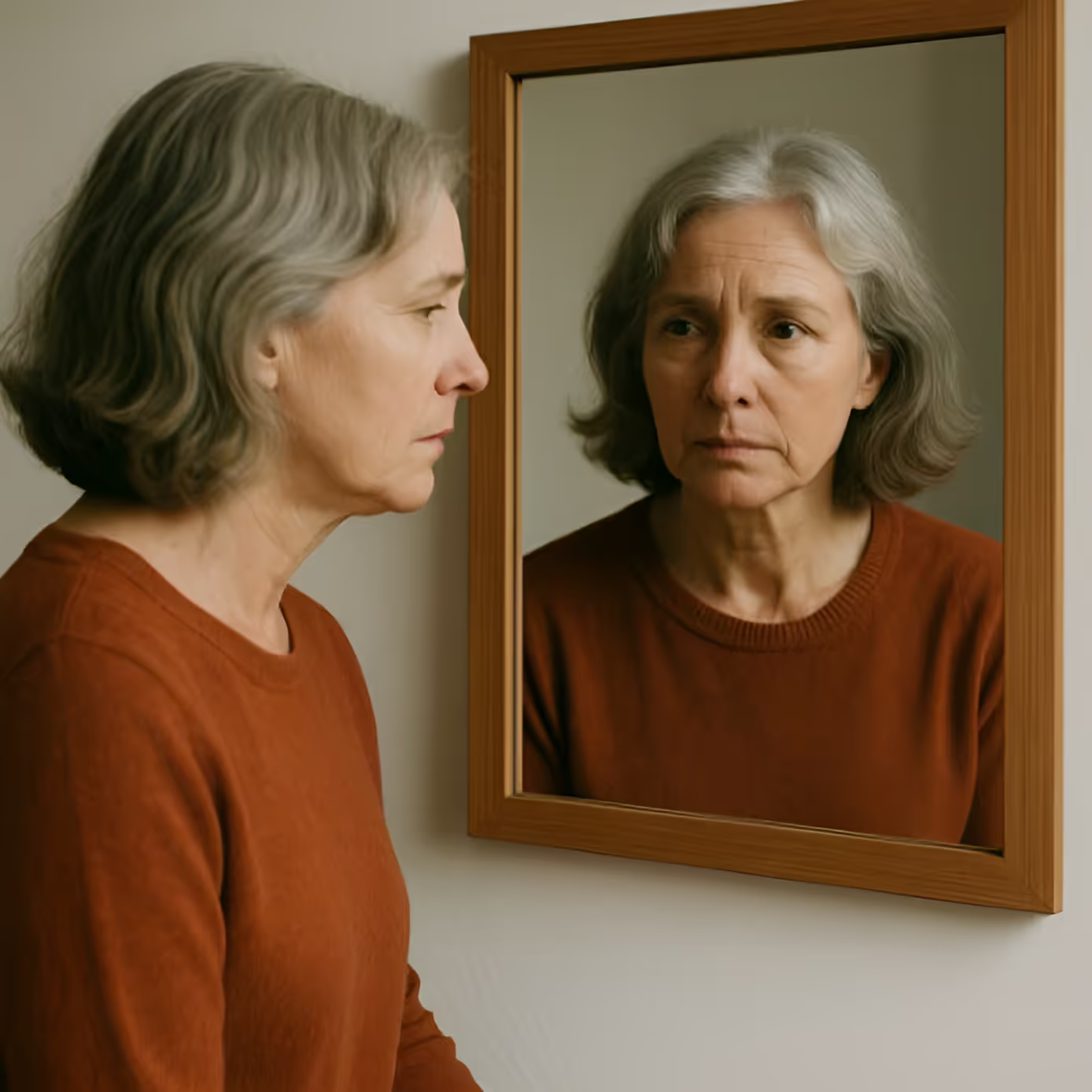
When Alice received her diagnosis, she hoped she could leave Harvard before the whispers began, before pity replaced respect. But how could she know when that moment would come? Staying too long terrified her. But leaving felt like losing herself. Who was she, if not a professor of psychology at one of the country’s most prestigious universities?
During my maternity leave, I felt a strong longing to return to work—not because I didn’t love my son, but because I feared being reduced to just one role. I am not just a mother. I am a doctor, a researcher, a woman, a wife. I work hard to keep all these parts of myself alive. And yet, Alice’s story forced me to pause. If I were given the same diagnosis, wouldn’t my family be the only ones I wanted to devote all my time to? Wouldn’t I want to be remembered, not for my titles or modest contributions to society, but for my love?
Alice’s departure from Harvard is not just the end of a career; it is the quiet collapse of an identity. And in that collapse there is beauty. There is courage. There is the beginning of something more intimate, more essential.
She had imagined a list of things to do before her mind slipped away—books to read, tasks to complete, routines to maintain. But then she laughed quietly, surprised by the clarity of her own realization. None of this was about her career. What she wanted was more sunny days, more ice cream, time with the love of her life, and the chance to see her grandchildren. And when the burden of her illness outweighed the joy of these simple pleasures, she wished to die—not out of despair, but out of a quiet, dignified understanding of what it means to truly live.
What Alice wants for herself is not extraordinary. It is heartbreakingly simple. She wants a future that doesn’t involve being confined to a dementia ward. She wants to spare her husband the emotional and financial burden of caring for a wife who one day may no longer recognize him. She refuses to become a burden, when simply continuing to live can feel more like a burden than a gift. Her clarity is brutal. Her love, selfless.
It is this love that guides her when the time comes to tell her husband. She could have made it easy and said, “John, I have Alzheimer’s,” in passing. But she doesn’t. She waits, not out of fear, but out of tenderness. She searches for the right moment, the right silence, the right strength. And when she finally speaks, she gives him everything: every forgotten word, every misplaced memory, every truth she’s hidden behind a brave smile.
At first, he resisted. He looked for other explanations. But then something changed—a memory, a glance—and suddenly he knew. That moment shattered me. John didn’t speak. He didn’t need to. His tears said it all. That kind of grief—the kind that asks no questions, demands no answers—is the kind that lives in the deepest layers of love. It reminded me of my own husband. Of how he holds my hand when words fail. Of the kind of understanding that exists only in silence, when two people know that something has changed forever, and yet they choose to stay.
Alice, too, felt the weight of what was happening. She feared not only the disease, but what it would do to the man she loved. She expressed her pain not with dramatic declarations, but with trembling gestures and gentle words. She tried to commit her husband to memory with her fingertips, to hold on to the contours of his face, the warmth of his presence. And when their tears met, it was not just sorrow; it was love, stripped of all pretense. It was a kind of intimacy that asks for nothing but gives everything.
One moment in *L’envol du papillon* has stayed with me more than any other: when Alice Howland, once an acclaimed cognitive psychologist, stands before an audience and delivers what she knows may be her last coherent speech. She speaks not as a scientist, but as a patient. The irony is cruel and profound: a woman whose life was built on understanding the mind now watches her own mind dissolve.
All too often, we speak of people with Alzheimer’s as being “gone” long before they die. But Lisa Genova never lets Alice become a mere shadow. Alice isn’t gone. She’s changing. Her intellect may fade, but her emotional core remains. She laughs, she cries, she loves. She is still Alice.
One day, a butterfly flutters past her, and suddenly she remembers being six or seven years old, crying in the garden when she learned that butterflies only live for a few days. Her mother had comforted her: “You see, they have a beautiful life.” That memory, fragile and fleeting, rises from somewhere deep within her, a reminder that even short lives, even fading senses, can hold something beautiful.
The butterfly, hinted at in the title, becomes a metaphor for Alice herself. Her transformation is marked by loss, yes, but also by grace. She learns to live in the present, to find joy in what is, even when the past and the future fade away. Genova’s novel transcends fiction. It becomes a meditation on what it means to be human. And it made me wonder: If I lost my memories, would I still be me? If I could no longer practice my profession, would I still feel useful? If I could no longer contribute in the ways I once did, would I still feel valuable? If my relationships began to fade, what would I hold on to? What would you hold on to? Alice’s story suggests that presence—being here and now—is enough. That a person, even without titles, roles, and achievements, retains their value.
Reading *L’envol du papillon* (Genova 2015) is not easy. It requires empathy. It asks us to imagine ourselves in Alice’s place, to feel the terror of forgetting, the humiliation of dependence, the sorrow of watching one’s life fall apart. But it also offers hope. Not hope for a cure, but hope for connection. For finding meaning even in decline.
In a world obsessed with productivity and intellect, Alice’s story serves as a reminder that our worth is not tied to our cognitive abilities. That dignity does not fade with memory. That love does not require perfect recall.
Lisa Genova has given us more than just a novel. She has given us a mirror. In Alice, we see our fears, our vulnerability, but also our strength. We see that being human isn’t about being flawless. It’s about being present, being connected, being loved. And for that, I am deeply grateful to her.


