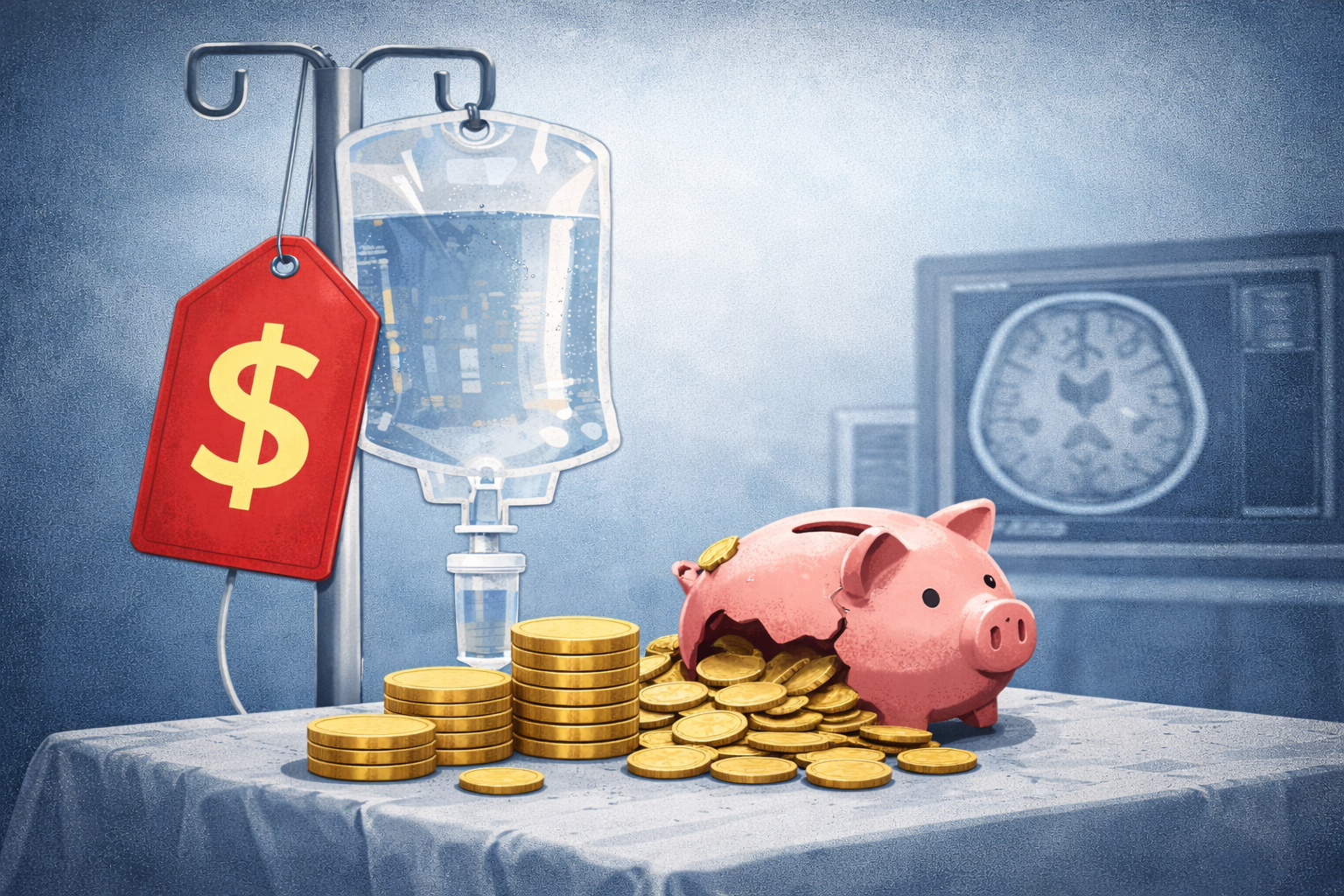
TLV's decision on the brake medicine Leqembi - "Not even cost-effective if the medicine were free."
In December 2025, TLV published a health economic assessment of Leqembi (lekanemab) on behalf of the NT Council (nationally organized introduction). The TLV report is not a "benefit decision" in the traditional sense (such as when a drug is included in the high-cost protection scheme), but rather a basis for decision-making by the regions via the NT Council. The TLV notes that the clinical study on which the approval is based shows that lekanemab:
significantly reduces amyloid plaques
slows cognitive decline in the study but at the same time there is considerable uncertainty about, among other things, how long the effect lasts and what happens when treatment is discontinued.
Which patients does the assessment concern?
The TLV's assessment applies to the evaluated indication (early Alzheimer's disease) in a more limited group:
mild cognitive impairment (MCI) or mild dementia due to Alzheimer's disease
confirmed amyloid pathology
non-carriers or heterozygous carriers of ApoE ε4 (i.e., not homozygous carriers in this assessment)
What does TLV base its calculations on – and what does “cost-effective” mean?
TLV uses a cost-benefit analysis where the benefit is measured in QALY (quality-adjusted life years). Simply put:
1 QALY ≈ 1 year in full health
Treatment can give you more years, a better quality of life, or both.
When TLV states that something is not "health economically justifiable," it means that:
the health benefits are too small or too uncertain in relation to the total cost (medicines + administration + monitoring + diagnostics + side effect management + care interventions)
Costs – what drives pricing?
1) The cost of medicines (in the report)
TLV reports costs per dose and per year, which vary according to weight range. Example from table in report:
189,410 SEK/year (40–50 kg)
284,180 SEK/year (50–70 kg)
378,820 SEK/year (70–100 kg)
473,590 SEK/year (100–120 kg)
SEK 568,230/year (120–140 kg)
2) Administrative costs (infusion in hospital)
Leqembi is administered intravenously. The company's administration cost in the model is stated as:
SEK 3,050 per administration occasion
which TLV estimates at approximately SEK 85,400 per patient per year in their plan.
3) Monitoring (including MRI due to ARIA risk)
The company's analysis assumes:
5 MRI scans in the first year, then 1 MRI scan per subsequent year
Cost per MRI in the model: SEK 2,494
4) Diagnostics and selection (examples of unit costs in the report)
The table presented by TLV includes:
CSF biomarker test: SEK 4,411
PET scan: SEK 18,087
ApoE ε4 test: SEK 3,654
The point: TLV's message is that it is not just the price of the drug itself that is expensive, but the entire "machinery surrounding it": diagnostics, infusion logistics, MRI checks, follow-up, and management of side effects.
TLV's result: SEK 3.7–4.3 million per QALY
TLV reports two scenario analyses (based on different assumptions about the natural course of the disease). In these, TLV concludes that:
Scenario analysis 1: approximately SEK 3.7 million per QALY
Scenario analysis 2: approximately SEK 4.3 million per QALY
This is far above what is normally considered reasonable in Swedish health economics practice (although there is no "fixed limit" that applies to all situations). The TLV's conclusion is therefore that it does not appear to be cost-effective under the current conditions.
"Not even if the medicine were free" – is that true?
In its report, TLV presents a figure showing the cost per QALY at different price levels (percentage of list price). This shows that even if Leqembi is assumed to have a drug cost of SEK 0, the cost is still around SEK 1.5 million per QALY – and TLV states that this is "primarily" due to high administration costs.
This is the background to media headlines claiming that "it wouldn't even be cost-effective if it were free."
Uncertainties and sensitivity analyses: results vary greatly
TLV writes that the results are sensitive to several assumptions. Examples:
In scenario analysis 1 , the cost per QALY in sensitivity analyses varies between approximately 2 and 8.2 million.
In scenario analysis 2, it varies between approximately 2.3 and 9.4 million.
Among the most "crucial" points are:
whether there is any residual treatment effect after treatment is discontinued
what administrative costs are assumed (different calculation methods yield significant differences)
assumptions about quality of life weights (how much quality of life is actually improved/maintained)
What is happening now in Sweden?
TLV has submitted its assessment to the NT Council.
The NT Council makes a balanced assessment and issues recommendations to the regions.
While waiting for this, there have been recommendations to delay implementation in order to avoid unequal treatment and decisions based on uncertain grounds.
What does this mean for patients and their families?
The TLV does not say that the drug "does not work" – they acknowledge its effect on amyloid and a slowdown in the study.
The TLV's main point is that the health benefits are uncertain in the long term and that the total cost will be so high that the benefits are not reasonably proportionate.
The next step is the NT Council's recommendation, and possibly negotiations/delineations regarding which ones may be relevant in that case.
FAQ - summary
Why is it so expensive if the drug itself is "only" one component? Because the treatment requires diagnostic selection, infusions, repeated MRI checks, and resource-intensive follow-ups, which, according to the TLV, significantly affects the cost/QALY.
Can the price be lowered to make it reasonable?
TLV shows that even at a very low price, significant costs remain from administration and monitoring, but a lower price can still improve the calculation—the question is how much, and how the uncertainty is handled.
Is this a definitive "no" in Sweden? No. TLV has submitted a health economic assessment to the NT Council. The NT Council will take a position and make a recommendation to the regions.
By clicking "Accept", you consent to cookies being stored on your device to improve website navigation, analyse website usage and assist with our marketing efforts. See our privacy policy for more information.