
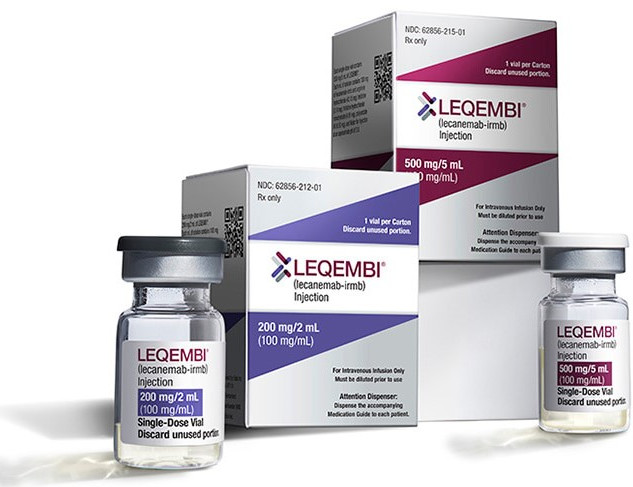
For the first time, patients with early-stage Alzheimer’s disease will be able to receive treatment with Leqembi without having to travel abroad.
The treatment will be offered privately, and the cost will be high. But this announcement also marks something much bigger: Alzheimer’s is shifting from a disease where healthcare has primarily been able to alleviate symptoms to one where, for some patients, it is actually possible to influence the course of the disease.
SvenskaDagbladet reports today that Executive Health will be the first Swedish clinic to offer treatment with Leqembi, with the first patient scheduled for early October. Until now, Swedish patients who wanted and were able to receive the treatment have had to travel repeatedly to Helsinki, London, or the United States, among other places. It is difficult to overstate the significance of this development. Leqembi, which contains the active ingredient lekanemab, does not cure Alzheimer’s disease nor does it restore cognitive function that has already been lost. However, the drug targets part of the underlying disease process by reducing amyloid in the brain and has been shown to slow the progression of the disease in people with early-stage Alzheimer’s disease. In 2025, it became the first drug of its kind to receive marketing authorization in the EU.
What does “bromsa” actually mean?
Thelarge Phase 3 Clarity AD study included1,795 people with early-stage Alzheimer’s disease. After 18 months, the group that received lekanemab had experienced less cognitive decline than the group that received a placebo. The difference in the study’s primary outcome measure, the CDR-SB, was 0.45 points, and the result is typically described as a roughly 27 percent slower rate of decline during the study period. It is important to understand what this means—and what it does not mean.
A patient does not begin treatment with the goal of regaining their previous memory. Instead, the goal is to slow the rate of functional decline. For a progressive disease, time can be an important treatment outcome: a longer period of maintained independence, communication ability, and the opportunity to participate in one’s normal life. At the same time, there is still uncertainty regarding the exact extent of the long-term benefit for an individual patient. This is also one of the reasons why Swedish authorities have been cautious in their health economic assessments.
This treatment is not suitable for everyone with Alzheimer's
Leqembiis approved for a specific group: people with mild cognitive impairment or mild dementia caused by Alzheimer’s disease, in whom the presence of amyloid in the brain has been confirmed. In the EU, patients must also not carry two copies of the ApoE4 gene variant. The treatment is approved for people with no ApoE4 copies or only one, since the risk of a serious side effect—ARIA—is higher in people with two copies. This means that simply experiencing memory problems and requesting the treatment is not sufficient. The diagnosis must be thoroughly evaluated, and the patient must be assessed based on factors such as disease stage, amyloid status, ApoE genotype, MRI findings, and other medical conditions. Executive Health also states that the clinic itself will not initiate the Alzheimer’s evaluation prior to treatment. The patient must be properly evaluated at a memory clinic before treatment can begin. This is an important change for diagnostics as well: the value of detecting Alzheimer’s early increases when there is a treatment that can only be administered during the early stages of the disease.
The treatment also requires follow-up
In the EU, Leqembiis administered intravenously every other week. Patients need to undergo regular MRI scans because the treatment can cause what is known as ARIA—changes involving swelling and/or small hemorrhages in the brain. Most ARIA changes do not cause any symptoms, but in rare cases, the condition can become serious. Therefore, MRI monitoring is a central part of the treatment, and certain patients—such as those with an increased risk of bleeding or those on anticoagulant therapy—cannot be treated. The current product information specifies MRI scans prior to, among other times, the third, fifth, seventh, and fourteenth doses. This is therefore not a medication that is simply picked up with a prescription and taken at home. It is a treatment regimen involving diagnostics, infusions, and safety monitoring.
And then there was the cost
Herelies the obvious limitation.
Executive Health has not yet announced an exact price, but told Svenska Dagbladet that the treatment will cost several hundred thousand kronor, while the goal is to keep costs below what Swedish patients have had to pay so far for treatment and travel to places such as Helsinki, London, and the United States. The clinic estimates the cost there at around 500,000–1 million kronor per year. That is a lot of money and means that, at present, the treatment is only accessible to a limited group who can finance it themselves. At the same time, there are two different perspectives on the cost that are important to distinguish:
For the public healthcare system, a treatment must be evaluated against other needs and treatments. The Swedish Health Products Agency (TLV) has estimated the cost at approximately 3.7–4.3 million Swedish kronor per quality-adjusted life year (QALY) gained in its scenario analyses, with significant uncertainty regarding, among other things, long-term effects and administrative costs. Following price negotiations, the NT Council recommended on April 17, 2026, that the regions not use Leqembi, as the benefit was not considered sufficient in relation to the cost. For the individual patient, the comparison looks different. In this case, several hundred thousand kronor is not offset by another equivalent disease-modifying treatment within the Swedish healthcare system— no such treatment is currently offered by the regions. That does not make the treatment cheap. And it raises a difficult and legitimate issue of equity. But it also means that the cost needs to be discussed with greater nuance than simply as a high price tag.
Why today’s announcement is bigger than just a new private healthcare service
Perhapsthemost interestingthingisn’t that a private clinic is starting to offer a new drug. What’s interesting is what’s happening to the entire logic surrounding Alzheimer’s disease.
For a long time, early diagnosis has presented a paradoxical problem: the earlier we detected the disease, the sooner the patient could receive information, support, and symptomatic treatment—but we still could not slow down the disease process itself. That situation is changing. Leqembi is not the cure for Alzheimer’s. Its effect is limited, the treatment is suitable only for certain patients, it carries risks, and it is expensive .But it establishes something that was previously missing: a treatment window early in the disease.
Thisalso makes issues such as early diagnosis, biomarkers, and access to memory assessments more urgent. For a patient tobeable to decide on treatment, the disease must be detected while treatment is still an option.
What should you do if you’re interested in the treatment?
Anyoneexperiencing memory problems or suspecting cognitive decline should not start by asking , “Can I get Leqembi?” but rather, “What is causing my symptoms?” First, a structured cognitive evaluation is needed. If this raises suspicion of early-stage Alzheimer’s disease, the evaluation can be expanded as needed to include biomarkers and other tests. Only then can it be determined whether treatment with Leqembi is medically appropriate at all.
For some, the answer will be no.
For others, there is now, for the first time, the possibility that the answer might be yes— and that the treatment can be administered in Sweden.
Thisis a significant step forward for Swedish dementia care.

